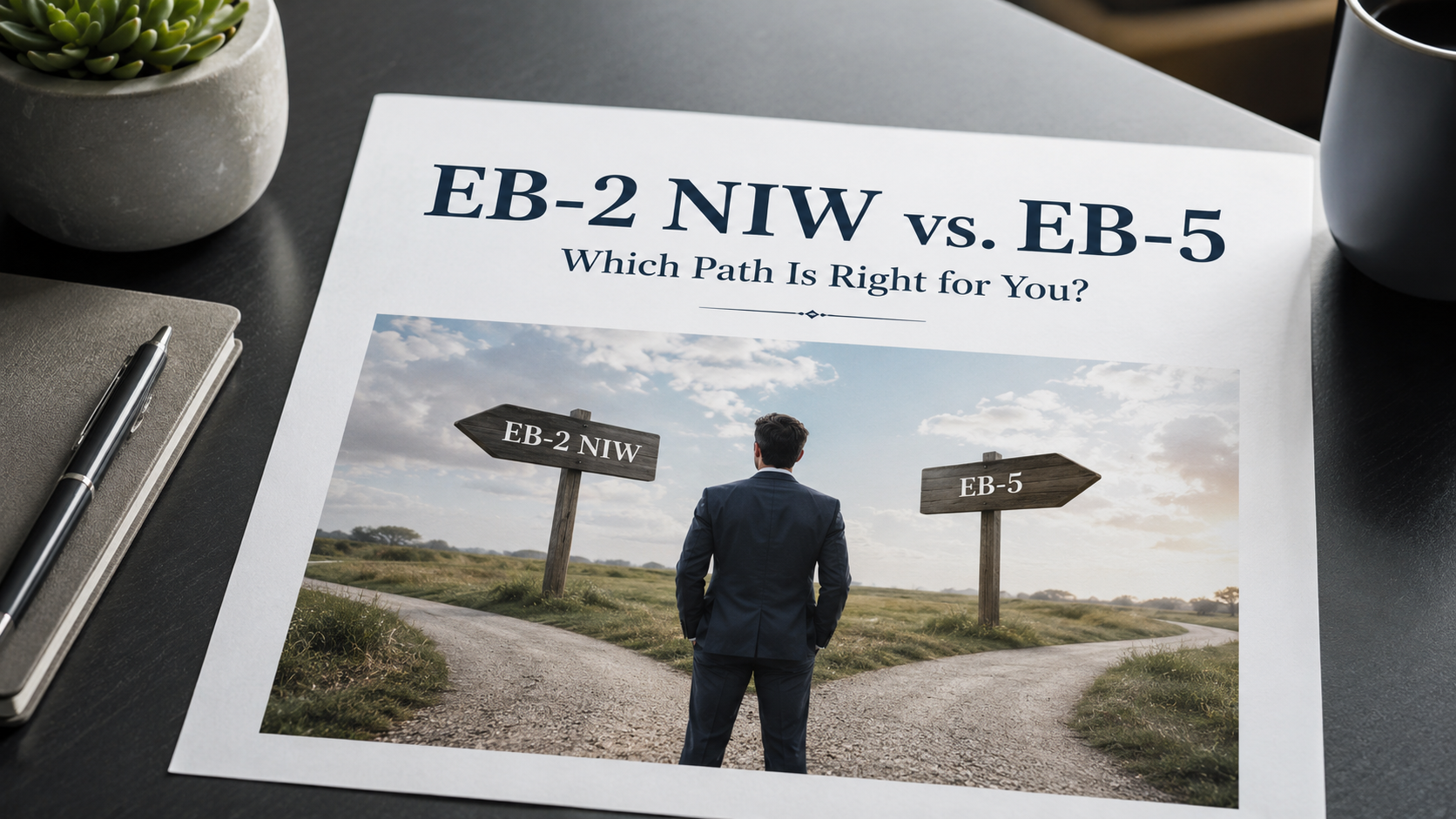
If you’re an Indian national on an H-1B visa, you know the EB-2 backlog is measured in decades, not years. The June 2026 Visa Bulletin shows India’s EB-2 Final Action Date at September 1, 2013 — meaning USCIS is currently issuing green cards to Indian nationals who established their priority dates over 12 years ago. For many H-1B holders, this reality has pushed EB-5 from a distant consideration to an active one. This post compares both paths, including cost, timeline, employer dependency, concurrent filing, and risk, so you can evaluate which one actually fits your situation.
Where Each Path Stands Today
The June 2026 Visa Bulletin puts the India EB-2 Final Action Date at September 1, 2013 and India EB-3 at December 15, 2013. Movement in these categories is measured in weeks per year. Even a generous projection puts most Indian H-1B professionals with recent priority dates 20 to 40 years from a visa number if the program remains unchanged.
EB-5 tells a different story. India’s EB-5 unreserved Final Action Date is May 1, 2022 — roughly nine years ahead of EB-2. But the more significant number is the reserved category: all three EB-5 set-asides — Rural (20% of the annual allocation), High Unemployment (10%), and Infrastructure (2%) — are current for every country, including India. No waiting for a visa number if you invest in a qualifying reserved category project.
Employer Dependency: The Difference That Matters Most
EB-2 NIW removes the requirement for an employer-sponsored labor certification — that’s the “National Interest Waiver” part. You petition for yourself. However, your underlying status while waiting for a visa number still depends on maintaining valid nonimmigrant status, which for most Indian professionals means staying on H-1B.
In practice: renewing your H-1B every three years, staying with an employer willing to maintain sponsorship, and remaining subject to the same layoff, employer change, and portability rules that define H-1B life. An approved I-140 provides some protection — H-1B extensions beyond the six-year cap and AC21 portability after 180 days — but you are still on a visa clock, still dependent on employer continuity, and still years or decades from a green card.
EB-5 breaks that dependency structurally. Once you invest and file your I-526E, your path to a green card is tied to your capital, not your employer. If you’re in a reserved category with a current visa number, you can file for Adjustment of Status (I-485) concurrently with your I-526E — meaning you could have work authorization and advance parole pending while your petition is being adjudicated. That changes your relationship with your employer immediately, not after a decade of waiting.
Timeline: What “Faster” Actually Means for Indian Nationals
For Indian nationals investing in a rural TEA project, the general EB-5 timeline looks like this: I-526E adjudication — currently running faster for rural petitions under USCIS’s Inventory Management Model (effective March 2026), with some approvals seen in the range of four to six months — followed by I-485 processing if you’re adjusting status inside the US. Conditional green card approval can realistically occur within 12 to 24 months of filing for investors in a current reserved category. The I-829 to remove conditions follows after the sustainment period is satisfied — generally two years after the investor’s funds are fully deployed to the new commercial enterprise.
For EB-2, no one can give you a reliable timeline. The current Final Action Date of September 1, 2013 reflects priority dates filed over 12 years ago. Assuming even modest forward movement, an Indian professional filing an I-140 today could be looking at 15 to 30 years before a visa number becomes available, and that assumes no retrogression, no legislative disruption, and continuous H-1B status throughout.
The EB-5 reserved category path is not marginally faster than EB-2 for Indian nationals. It is categorically different. The question is not which path is quicker — it’s whether the investment requirement is a workable constraint given the timeline difference.
Cost Comparison: EB-5 Investment vs. Decades on H-1B
EB-2 NIW is inexpensive by immigration standards. Filing fees, attorney costs, and USCIS charges typically total $5,000 to $15,000 depending on counsel and case complexity. There is no capital requirement. The cost is time and continued employer dependency.
EB-5 through a TEA regional center project requires a minimum investment of $800,000, plus applicable administrative fees. Your capital is placed at risk in a real estate or infrastructure project, and returns — if any — are generally modest. This is an immigration vehicle with a capital cost, not a wealth-building strategy.
The honest comparison is not $10,000 versus $800,000. It’s $800,000 invested now versus 15 to 30 years of H-1B renewals, potential career constraints, and the compounding cost of deferred financial and personal decisions that come with not having a green card. For many Indian professionals, the real question is whether $800,000 is accessible and whether a certain timeline is worth more than an uncertain one.
Risk Profile: Where Each Path Can Break Down
EB-2 NIW carries immigration risk that is easy to underestimate. The most common failure points: denial of the NIW petition (the national interest standard requires careful case-building and is not automatic), job loss that disrupts H-1B status, employer unwillingness to extend sponsorship, or a policy change that affects priority date movement. An approved I-140 survives employer changes under AC21, but your underlying status does not — you still need a valid nonimmigrant visa to remain in the US while waiting.
EB-5 carries a different kind of risk: investment risk. Your $800,000 is deployed into a commercial project. If the project fails, you could lose capital — and if job creation requirements aren’t met, your I-829 petition could be denied. USCIS requires that the jobs were actually created; a project that underperforms on job creation is an immigration problem, not just a financial one. Due diligence on the project, the regional center’s track record, the capital structure, and the job creation methodology is core to the decision.
There is also regulatory risk on the EB-5 side. The Regional Center Program is currently authorized through September 30, 2027. Investors who file their I-526E by September 30, 2026 are protected by a grandfathering provision — USCIS must continue processing their petitions even if the program lapses after that date. Missing that filing deadline does not eliminate EB-5 as an option, but it removes that specific protection.
Concurrent Filing: A Major Advantage for H-1B Holders Inside the US
One of the most underappreciated aspects of EB-5 for H-1B holders already inside the US is concurrent filing. When a visa number is immediately available — as is currently the case for Indian nationals in all three reserved EB-5 categories — you can file your I-526E and your I-485 at the same time. This triggers eligibility for an Employment Authorization Document (EAD) and Advance Parole (AP) while your case is pending.
In practical terms: you could apply for your own work authorization and travel document while your green card petition is being reviewed. EAD and AP processing takes several months, but once issued, you are no longer dependent on your employer maintaining your H-1B during adjudication. That is a material change to your situation, not a procedural footnote.
EB-2 NIW does not offer this benefit until a visa number is actually current. For most Indian nationals filing today, that is not on any near-term horizon.
The Hybrid Strategy: Pursuing EB-2 NIW and EB-5 Simultaneously
Some Indian professionals pursue both paths simultaneously — filing an EB-2 NIW I-140 to establish an early priority date and preserve optionality, while actively pursuing EB-5 as the primary vehicle. This is a legitimate approach. An EB-2 NIW petition does not preclude an EB-5 filing, and locking in an early priority date costs relatively little.
The practical value of a hybrid strategy depends on your timeline flexibility. If you have runway on your H-1B and are not under immediate status pressure, maintaining an EB-2 priority date while pursuing EB-5 gives you a fallback. If Congress significantly reforms the employment-based backlog — a recurring but as yet unrealized possibility — an established EB-2 priority date could become meaningful. The hybrid approach requires attorney fees and active management of both cases, but for investors who can sustain that, it preserves options without foreclosing either route.
Key Takeaways
- India’s EB-2 Final Action Date of September 1, 2013 reflects a backlog most Indian H-1B professionals cannot realistically clear within 20 years under current conditions.
- EB-5 reserved categories — Rural, High Unemployment, and Infrastructure — are current for India right now, with no waiting for a visa number in those set-asides.
- US-based Indian investors in a current EB-5 reserved category can file I-485 concurrently with their I-526E, opening access to EAD and Advance Parole while the case is pending — a direct path off employer dependency.
- EB-2 NIW carries no capital requirement but keeps you on an H-1B clock for potentially decades; EB-5 requires $800,000 at risk but can produce a conditional green card within one to two years for reserved category investors.
- EB-5 investment risk is real — project due diligence, job creation methodology, and regional center track record are material factors, not secondary concerns.
- Pursuing both paths simultaneously — EB-2 NIW to lock in a priority date, EB-5 as the primary vehicle — is a viable strategy for investors who want to preserve optionality without foreclosing either route.
- Investors who file their I-526E by September 30, 2026 are protected by the RIA grandfathering provision; those who wait until after that date lose that specific filing protection, though EB-5 remains available through the program’s authorization date of September 30, 2027.
Next Steps
If you’re evaluating EB-5 as a serious alternative to the EB-2 backlog, the next step is to consult with an immigration attorney to discuss your specific situtation, alongside a close look at available rural TEA projects. Schedule a consultation with our team to learn more.
Disclaimer: This update is provided for informational purposes only and does not constitute legal or investment advice. Visa availability is subject to change, and individual circumstances may vary. Prospective investors should consult with qualified immigration counsel and review all offering documents before making any investment decision.